
Service Leadership recently released benchmarking data that made me do a double take. They’re showing that the cost to acquire a new managed services client is not a few hundred dollars, and it is not just a few thousand. It’s tens of thousands of dollars. When you actually factor in marketing, sales effort, time, and inefficiency, the cost to acquire new business climbs fast. It is the kind of number that makes you stop and really think about how most MSPs are approaching growth right now. And honestly, I understand why it makes owners hesitate to even invest in creating new business pipeline.
When acquiring a new client is that expensive and that time consuming, referrals start to look like the obvious answer. They are easier, they convert faster, and there is already trust built in. It feels like the smarter, more efficient path. But the tradeoff is control. You cannot predict referrals, you cannot scale them, and you cannot rely on them to support consistent growth. So while they are valuable, they cannot be the strategy.
At the same time, what is happening across a lot of MSPs right now is not helping. There is a constant push to do more. More tools, more campaigns, more automation, more AI layered on top of things that were not working to begin with. It feels productive, but it is not necessarily effective. And that is exactly why those acquisition costs are so high. Instead of focusing on the activities that actually lead to real conversations with the right prospects, IT businesses are throwing everything at the wall to see what sticks. Over time, that creates a very expensive way to not generate consistent new business.
I have spent a significant amount of time in this space, getting into the details of what MSPs are actually doing, what is working, and what is not. What worked even six months ago is not always working today, which makes this even more frustrating. But one thing is very clear; there is no option to sit back and wait for business to come to you.
Your competitors are not doing that. They are learning faster, moving faster, and getting in front of the same businesses you want to work with. And once they establish those relationships, it becomes very difficult to break in later. So the answer is not to do more. It is to stop doing the things that are not working and start focusing on the things that are. It does not have to be complicated. But it will require doing the things most MSPs are not willing to do.
Build a Real Go-To-Market System
One of the biggest issues I see is that there is no real system for managing pipeline. Everything lives inside of a PSA, or in someone’s head, or in a tool that was never designed to support sales. There is no clear visibility into what is happening, no consistency in follow-up, and no real way to measure what is working. You need a real CRM. Somewhere you can actually build and manage a pipeline, track activity, and understand how deals are moving. You need a Kanban-style view where you can see opportunities from first conversation through close. You need defined stages, clear next steps, and accountability around movement.
There has been a lot of adoption recently around platforms like HubSpot and GoHighLevel, but from what I have seen, HubSpot is the stronger option for MSPs. It is a real CRM. You can pull data, build custom reports, manage permissions, and actually use it as a system of record. It allows you to adapt as things change, which is critical right now because the market is shifting quickly. But having the system is only the first step. The real question is what you do with it.
Get Clear on Who You Are Going After
This is where things get very real, very fast.
Everyone says they know their ideal client. They say it casually. “Yeah, we work with small businesses,” or “we like companies with 10 to 50 users.” That is not enough. If it is not written down, if it is not clearly defined, it does not exist.
And this matters because building a list is not easy.
There is no perfect data source. I have used ZoomInfo, I have used scraping tools, I have used enrichment tools, and it is all the same. The data is messy. Industries are wrong, company sizes are wrong, addresses are outdated, and emails bounce. I have pulled lists that looked perfect on paper, only to realize after verifying on LinkedIn that half the companies were misclassified.
It takes a significant amount of time to clean that data, filter it, and get it into a usable state. Which is exactly why you need to be intentional about who you are targeting.
And once you have that list, you are not done. You have to go get in front of them. Repeatedly. That part never changes.
Execute Against a Real Plan
This is where most MSPs fall apart.
They take action, but there is no plan behind it. They are sending emails, posting on LinkedIn, trying different tools, but there is no structure. There is no consistency. There is no defined approach.
What is working is much simpler than people expect. You write down your plan and you execute it long enough to see results.
The most expensive thing you can do right now is execute without a plan.
Make Your Value Visible
Most MSPs are doing good work, but they are not making it visible.
And this is not just a delivery problem. It is a sales and positioning problem.
Saying you offer “24/7 support” does not differentiate you anymore. Saying you are “proactive instead of reactive” does not differentiate you anymore. Everyone says that. It is table stakes.
What actually separates you is your ability to show your work.
That means giving prospects and clients visibility into what you are doing, what is happening in their environment, where the risks are, and what you are actively improving.
This is where tools become a competitive advantage.
Client portals, executive dashboards, compliance scoring, real-time reporting – these are not just internal tools. These should be front and center in your sales process, on your website, and in your conversations with prospects. You should be showing people exactly how they will experience working with you before they ever sign a contract.
But here is the part most people miss.
You cannot just promote it. You actually have to do it.
That means introducing clients to the portal during onboarding. Having them log in themselves. Walking them through it. Referencing it in meetings. Pointing back to it consistently so it becomes part of how they understand your value.
If you have a portal and it is not being used, or it is not clearly showing your value, it is not helping you.
At that point, you need a better one.
This is where something like FITware comes in. It is designed specifically to make MSP work visible in a way that clients actually understand. It connects operational data to client-facing insights so that value is not buried in tickets and reports. When you can clearly show performance, risk, and progress, the entire conversation changes – from justification to alignment.
Leverage Operational Data to Drive Revenue
This is one of the most underutilized areas in most MSPs.
There is a massive amount of data already sitting inside your business – utilization rates, technician time, client profitability, ticket volume, response times, contract alignment and most of it is not being used to drive revenue decisions.
Instead, it is either ignored or only looked at reactively.
If you start looking at that data more intentionally, it changes how you grow.
For example, utilization. If your team is underutilized, that is not just an operations issue. That is a revenue issue. It means you have capacity that is not being monetized. On the flip side, if your team is overutilized, you are going to run into service issues that impact retention and limit your ability to grow.
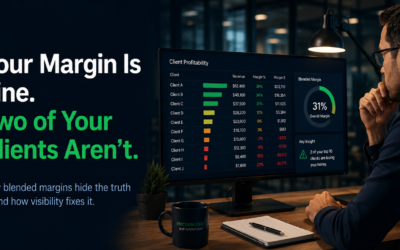
Client profitability is another big one. Not all MRR is good MRR. If you are not looking at which clients are profitable and which ones are not, you are missing opportunities to adjust pricing, restructure agreements, or have meaningful conversations about scope.
Then there are cross-sell and upsell opportunities. When you can see which clients are missing key services – security layers, compliance coverage, infrastructure upgrades – you are no longer guessing. You are identifying real gaps and bringing solutions to the table.
This is where having the right reporting layer becomes critical.
Tools like FITware are built to bring all of this together in one place. Instead of pulling data from multiple systems and trying to piece it together manually, you can see utilization, client health, compliance, and opportunity areas in a single view. That allows you to prioritize where to focus, both internally and externally.
And more importantly, it allows you to turn operational insights into revenue conversations.
Instead of saying “we recommend this,” you are showing why it matters, backed by real data.
That is a very different conversation.
Final Thoughts
If it really costs $29,000 to acquire a new client, then doing random activity is no longer an option.
You cannot afford it.
You do not need to be everywhere. You do not need to do everything. And you definitely do not need to keep doing things that are not working just because they feel like “marketing.”
What works is focus. Knowing who you are going after, executing against a real plan, leveraging your existing clients for growth, and using your tools in a way that actually supports those efforts.
Less noise. More intention. More conversations that actually lead somewhere.
That is what is working right now.