
Every MSP has one. The name that pops up on your phone and makes your stomach drop. Before you fire them – read this.
It’s 2:47 on a Tuesday afternoon. Your phone buzzes. You glance down, see the name, and feel that specific, particular dread – the kind that lives somewhere between your stomach and your chest. You know this call. You’ve had this call seventeen times in the last ninety days.
You take a breath. You answer.
For MSP owners and service managers across the country, this moment is not hypothetical. It’s Tuesday afternoon every week. And the uncomfortable truth that nobody wants to admit in polite company – the truth that lives in every MSP community forum thread titled “do I fire this client?” – is that the problem usually isn’t entirely the client’s fault.
Sometimes it is. But not always. And knowing the difference is worth a lot of money.
“Before you fire the client, ask yourself one honest question: do they actually know what good looks like from us?”
– A question worth sitting with
How a “Difficult Client” Gets Made
Nobody signs a managed services agreement hoping to become the client everyone dreads. It doesn’t start that way. It starts with a bad onboarding, or a handoff that fell through the cracks, or a ticket that sat unresolved for nine days while your team was swamped with three other fires. It starts with a client who expected one thing and received something slightly different – repeatedly.
Over time, that gap between expectation and delivery calcifies. The client starts calling more. They escalate faster because they’ve learned that’s the only way to get traction. They cc their whole executive team on every ticket. They become the client everyone dreads calling back – not because they’re inherently difficult, but because the relationship drifted into a pattern that nobody actively managed.
This is how most “difficult clients” are made. Not with malice. With drift.
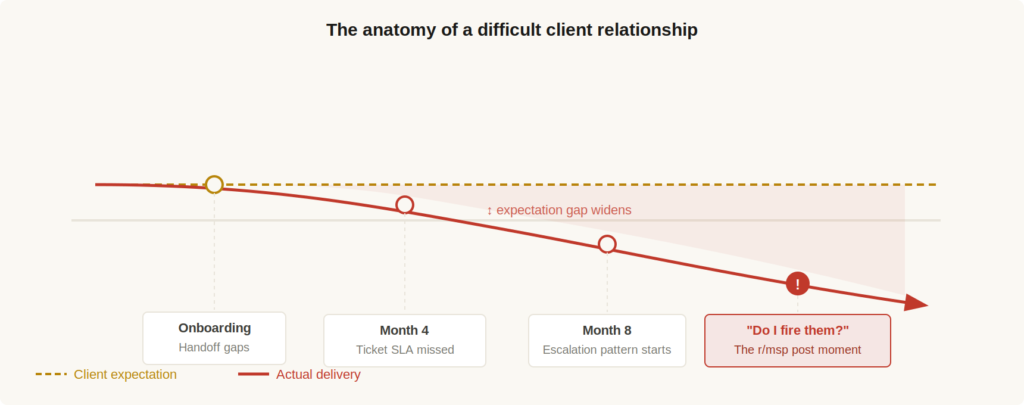
The difficult client isn’t born that way. The gap is built slowly, one missed touchpoint at a time.
The r/msp Version of This Story
If you’ve spent any time in the Managed Service Providers subreddit, you know the post. It shows up every few days, worded slightly differently each time. “Client won’t stop calling after-hours.” “Client CCing their CEO on every ticket.” “Client threatening to leave but we’d honestly be relieved.” The comments are always split between “fire them immediately” and “here’s what I’d try first.”
The fire-them camp is emotionally satisfying. There’s a whole philosophy around it – that the energy you spend managing a high-maintenance client is energy stolen from clients who appreciate you. And that’s true. Sometimes. But what the thread almost never explores is this: what percentage of these clients became difficult because of something on the MSP’s side?
Not a small percentage.
What “Difficult” Actually Looks Like Under the Hood
There are genuinely difficult clients – people who are emotionally volatile, who move goalposts constantly, who would never be satisfied regardless of what you delivered. They exist. These are clients often best fired.
But before you get there, it helps to understand the three archetypes that actually show up most often in MSP relationships:
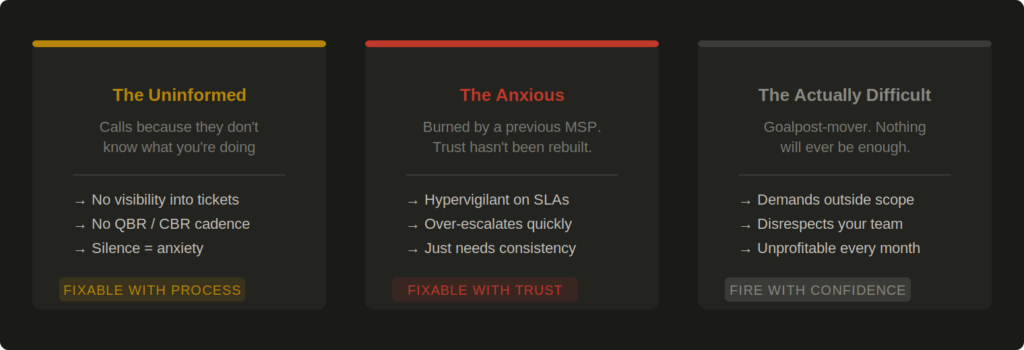
Two of the three archetypes are recoverable. Knowing which one you’re dealing with changes everything.
The first two – The Uninformed and The Anxious – are clients you can win back. Not with heroics, but with structure. With a communication cadence that removes uncertainty. With visibility that replaces the anxiety of not knowing. With a business review that shows them exactly what you’ve done and why it matters.
The third archetype is the one who belongs on the offboarding list. But most MSPs never do the diagnostic work to figure out which one they’re actually dealing with. They just know the call makes their stomach drop, and eventually they act on that feeling.
The Hidden Cost of Getting This Wrong
Misidentifying a recoverable client as an unfixable one costs you more than you think. Not just the revenue – the MRR, the potential referrals, the anchor they provide for a vertical or geography. The cost is also the story it tells internally. When an MSP fires clients reactively, without data, without a process, it signals something to your team: that the answer to hard problems is avoidance.
And when you keep a genuinely toxic client because you’re afraid of the revenue hit, you pay a different price – in team morale, in ticket volume, in the quiet resignation of the tech who fields their calls every week.
Both errors are expensive. The solution to both is the same: better data, clearer visibility, and a documented process for evaluating client health before you make the call.
This is exactly where FITware’s Client 360° view changes the conversation. Instead of going on gut – “this client feels like trouble”- you’re looking at real profitability data, support volume trends, and CX Indicators together. You’re having a business conversation instead of an emotional one. And that changes the decision every single time.
What Winning a Difficult Client Back Actually Looks Like
A few years ago, an MSP in the mid-Atlantic region was ready to fire one of their longest-running clients. The relationship had deteriorated over about eighteen months. Support volume was high, the primary contact was hostile on calls, and the account manager had requested to be rotated off the account twice.
Before pulling the trigger, the owner did something unusual: she called the client’s CEO directly – not to apologize, not to negotiate but to ask a single question: What does good look like to you, and are we anywhere near it?
The answer was illuminating. The client had no idea what the MSP was doing proactively. Every interaction they’d had was reactive. They’d never had a business review. They’d never been shown the backup reports, the patch compliance numbers, the security posture improvements. From where they sat, they were paying a significant monthly fee for a help desk that sometimes fixed things slowly.
That MSP didn’t fire that client. They implemented a quarterly business review, started sending a monthly one-page health summary, and assigned a dedicated point of contact. Within two quarters, that client became a reference account.
The friction wasn’t in the client. It was in the gap between what was being delivered and what was being communicated.
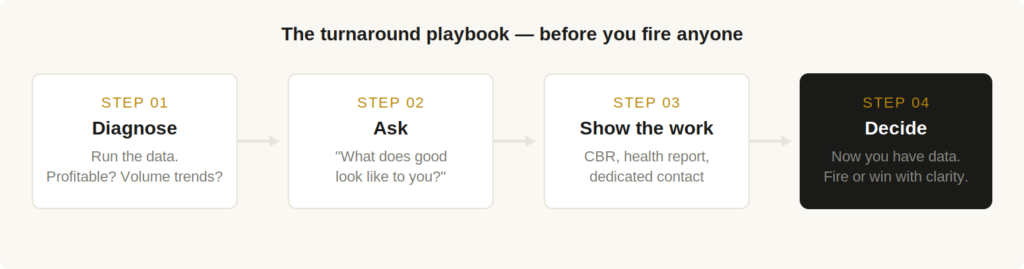
The difference between a reactive offboard and a strategic one is three steps of due diligence.
Building a Practice Around Client Health – Not Gut Instinct
The MSPs that handle difficult clients best aren’t the ones with the most patience. They’re the ones with the best systems. They know – before the client calls to complain – that a relationship is drifting. They have CX indicators that flag early warning signs. They have utilization and profitability data that tells them whether a difficult client is also a costly one, or whether they’re actually one of the more profitable accounts in the book.
That changes the conversation entirely. You stop managing by emotion and start managing by information. And when you have to have a hard conversation – whether that’s “we need to restructure our agreement” or “this relationship has run its course” – you’re having it from a position of clarity, not frustration.
The goal isn’t a portfolio of easy clients. The goal is a portfolio of well-managed ones.
“The clients who call the most aren’t always the ones costing you the most. But you’ll never know that without the data to check.”
– A distinction that’s worth money
A Different Question to Ask Yourself
Before you draft that offboarding notice – before you post to r/msp – ask yourself honestly: have I shown this client what excellent looks like from us? Have I given them a cadence of communication that removes the anxiety of silence? Do I actually know whether this account is profitable, or am I just tired of the calls?
If you can’t answer those questions confidently, the problem might not be the client. It might be the absence of a system that answers them automatically.
That’s a solvable problem. And the MSPs solving it are turning difficult clients into loyal ones – and gaining referrals they never expected from relationships they almost ended.