

You close three new logos in a single week. A great week! Your sales team gets a bonus, the pipeline dashboard looks like something worth screenshotting. Three weeks later the onboarding queue is backed up, two of your best techs are covering tickets for clients they’ve never met, and an account you’ve had for six years, one that never complains, sends a short, polite email asking why response times have slipped.
Nothing about the growth was fake. The deals were real, the clients are real, the revenue is real. What wasn’t real was the assumption sitting quietly underneath the celebration: that delivery could just absorb it. Growth didn’t break your MSP. The gap between your pipeline and your capacity did.
“Every new client makes your existing clients’ experience slightly worse – until you build growth around the capacity to actually deliver it.”
How growth quietly outruns delivery
Sales and delivery run on different clocks. Sales measures success in signed contracts this quarter. Delivery measures success in tickets closed, SLAs met, and onboarding done right – this week, every week, forever. Nothing forces those two clocks to stay in sync. A sales team hitting quota has no built-in signal that tells it delivery is already stretched thin, because that signal usually doesn’t exist anywhere anyone’s looking.
So growth happens the way water finds a crack. The pipeline fills, deals close, and delivery is expected to figure it out – because it always has before. It works right up until it doesn’t, and the moment it stops working isn’t obvious until an existing client says something, or a new client churns in month two because their onboarding was rushed by a team that was already underwater.
The conversation happening on the forums
“We tripled MRR this year and I’ve never worked harder or felt worse about it” shows up on forums in some form every few weeks, and the replies are almost always the same two camps: people telling the owner to hire faster, and people quietly admitting they went through the exact same thing and never really fixed it, just outlasted it. Almost nobody in those threads asks the question that actually matters: was the new revenue ever checked against what the team could handle before it was signed?
Growth gets celebrated as an unqualified good in this industry, right up until the CSAT scores and the Glassdoor reviews tell a different story a year later.
Three ways MSPs actually grow
Almost every growing MSP fits one of three patterns. Only one of them survives its own success.
The Land Grab says yes to every deal that moves, on the theory that revenue now solves problems later. It works for a quarter or two. Then support quality erodes across the board – new and old clients alike – because nobody was ever tracking whether “later” had arrived.
Feast or Famine overcorrects. After one bad growth spurt, the owner gets gun-shy, slows sales to a crawl, over-hires out of anxiety, and ends up with idle capacity and a pipeline that dried up right when the team was finally ready for more. The pendulum just swings the other direction.
The Capacity-Matched Grower treats delivery capacity as a real constraint on the sales motion, not an afterthought to it. Pipeline targets get set against what the team can actually absorb this quarter, hiring happens ahead of the gap instead of in a panic behind it, and growth feels steady instead of like a controlled demolition every other quarter.
What good looks like: growth that doesn’t cost you the clients you already have
Picture the same three closed logos, but this time sales and delivery had a real conversation before the ink dried. Delivery already knew a hire was in progress, timed to land two weeks before the new clients’ onboarding started. The sales team had a rough sense of what “at capacity” looked like this quarter, so the deals that closed were ones the team could actually take on well – not just take on.
The revenue is the same. The experience – for the new clients, the existing ones, and the team delivering the work – is completely different.
Building a system around growth, not adrenaline
Most MSPs don’t have a growth system. They have a sales team that’s rewarded for closing and a delivery team that’s expected to cope, with no shared number connecting the two. That works fine at a small enough scale that nobody notices the gap. It stops working the moment growth becomes real.
A system here doesn’t mean slowing down. It means giving sales a real capacity number to sell against, giving delivery visibility into what’s in the pipeline before it closes, and reviewing both together on a cadence that catches the gap while it’s still small enough to fix quietly.
“Growth doesn’t have to feel like a controlled demolition every other quarter. It just has to be planned like one is possible.”
A different question to ask yourself
The usual question after a good sales quarter is: how do we close even more next quarter? The more useful question is: could our delivery team have absorbed this quarter’s growth well – not just survived it? If the honest answer is no, that’s the number worth fixing before the next deal closes, not after.
The revenue you’re chasing is real. So is the client sitting quietly on your roster right now, wondering why things feel a little slower than they used to.
FAQs:
1. How do I know if my delivery team can handle new clients right now?
Use FITware to look at current utilization, not gut feel – if your senior techs are already running above 85-90% billable capacity, you don’t have room to absorb a new client well. A rough rule: if onboarding a new account would require pulling hours from existing client work, you’re not ready yet, even if the deal is good.
2. Should I ever turn down a deal because of capacity?
Sometimes, yes – or at least delay the start date. A deal that gets you a distracted, under-resourced first 90 days with a new client often costs more in early churn and reputation than the revenue is worth. Pushing the start date two or three weeks while you hire or reshuffle is usually a better move than saying yes and scrambling.
3. How far ahead should I be hiring relative to sales growth?
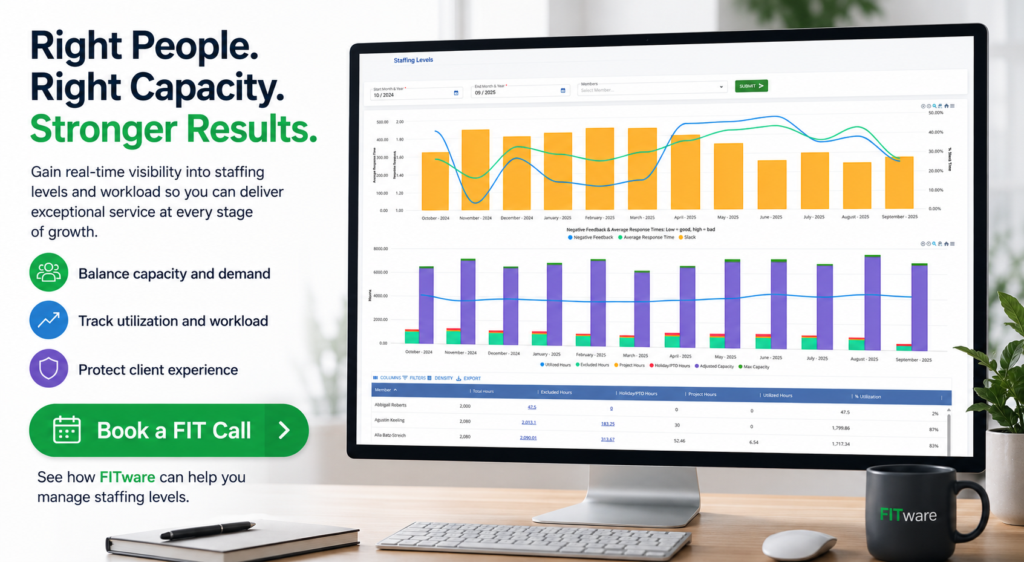
As a general guide, start the hiring process when your pipeline hits roughly 70-80% of what your next hire would offset – not after the deal signs. Hiring reactively after a growth spurt means your existing clients absorb the gap for weeks or months while the new hire ramps up. FITware’s Staffing Level Report can help identify when to hire new techs.
4. What’s the fastest way to see if growth is already outpacing delivery?
Two numbers tell you most of the story: SLA/response time trends for your existing clients over the last two quarters, and new-client churn in the first 90 days. If either one is quietly getting worse while revenue is going up, that’s the gap showing itself before anyone says it out loud.
5. How do sales and delivery actually stay in sync without slowing down growth?
It doesn’t require a big process – usually a shared capacity number that sales can see before a deal closes, and a short recurring check-in between sales and delivery leads. The goal isn’t to slow sales down, it’s to make sure what’s being sold matches what can be delivered well.