

The P&L looked fine. Revenue was up fourteen percent year over year, the blended margin was sitting at thirty-one percent, and the owner – let’s call him Marcus – had just booked a family holiday for the first time in four years. Things were good. The business was working.
Then a CFO friend asked him a single question at dinner: “What’s your margin on your ten biggest clients individually?”
Marcus didn’t know. He’d never looked at it that way. It took him three weeks and a spreadsheet he never wants to see again to find out the answer. Two of his top-ten clients were losing him money. A third was barely breaking even. And the blended margin number he’d been proud of existed because four clients were subsidizing the other six.
“A healthy blended margin is a dangerous number in an MSP. It tells you everything is fine right up until it isn’t.”
The number that hides everything
Blended margin is a useful number for your accountant. It is not a useful number for running an MSP. The problem is that MSPs are not single-product businesses – they are portfolios of client relationships, each with its own cost structure, ticket velocity, escalation pattern, and senior engineer dependency. Averaging all of that into one percentage is like averaging the temperature of your office building and concluding the server room doesn’t need air conditioning.
This is how margin erosion actually happens in a managed services business. It doesn’t show up dramatically. There’s no single bad quarter, no obvious turning point. Instead, you take on a client that costs a little more to serve than you priced for. You hire a technician to cover the load, but their time gets absorbed across the whole board, not just that client. You renew the contract at the same rate because the client seems happy and you don’t want the conversation. Repeat that cycle three or four times and the blended number barely moves but the real picture underneath has shifted completely.
The MSPs who figure this out early tend to share one characteristic: they got uncomfortable with aggregate numbers. They wanted to know which clients were actually profitable, which engineers were actually productive, and whether growth was making the business healthier or just bigger.
What keeps being learned the hard way
You’ll notice a recurring confession threads out there: the owner who just realized they’re working harder than two years ago but taking home less. Or the one who fired a “bad” client and suddenly had breathing room they couldn’t explain. Or the person asking whether a thirty percent margin is good – and getting twenty different answers because nobody’s measuring it the same way.
Profitability in an MSP is not usually a benchmarking problem. It’s typically a visibility problem. Whether the percentage is good depends entirely on your cost structure, your delivery model, your pricing, and whether that number is real or blended-into-fiction. There is no benchmark that fixes the fact that you don’t know which parts of your business are making money and which parts are quietly bleeding.
Following the money: what the numbers actually show
Let’s stay with Marcus for a minute, because his story is not unusual.
When he finally ran the numbers by agreement, the pattern that emerged was one most MSP owners recognize immediately once they see it: a handful of clients generating clean, high-margin revenue; a larger middle group doing okay; and a tail of clients that had been underpriced at the beginning of the relationship and never repriced since. That tail wasn’t just low margin. When he factored in the senior engineer hours being consumed, the after-hours calls, and the custom configuration work that always fell outside the scope of the agreement, two of those clients were net negative.
The problem wasn’t the clients. They weren’t bad clients. They were clients who’d been sold a price that didn’t reflect the true cost to serve them. And since nobody had ever looked at the actual hours going into those accounts, the problem had been compounding quietly for three years.
Here’s what makes this hard to catch without the right data: the clients causing the margin problem are rarely the ones generating complaints. High-volume, high-touch clients often have good relationships with your techs. They know your team by name. The account manager likes them. The situation doesn’t feel like a problem, it feels like a busy account. Only the financial layer reveals that “busy” and “profitable” are not the same thing.
The layer that should be looked at: engineer-level profitability
Client profitability is one half of the margin picture. The other half is your delivery team.
Most MSPs know their total labor cost. Very few know what any individual engineer is generating in billable or productive output relative to their fully-loaded cost. This matters for two reasons. First, it tells you whether your staffing model is actually profitable, whether the team you’ve built can support the margins you need, or whether you’re slowly growing payroll faster than you’re growing revenue. Second, and more importantly, it tells you something about where your good people’s time is going.
It’s not unusual for senior engineers to spend a disproportionate amount of their time doing work that doesn’t require their expertise. They get pulled into tickets by junior techs who need hand-holding. They handle escalations from the same three clients every week. They do the custom work that falls outside scope because there’s nobody else who knows how. Every one of those hours is expensive, and most of it is invisible in the aggregate numbers.
The cost of this isn’t just margin compression. It’s also your best people burning out on work that shouldn’t require them. And then leaving. Which starts the whole hiring cycle again at a cost most owners significantly underestimate.
This is the specific problem FITware’s reports were built to solve – not just surfacing the blended number, but giving you real-time visibility into which agreements are generating margin and which are consuming it, and how your team’s productive hours map to the revenue those clients represent. When you can see both layers at once, the decisions become obvious. The hard part is no longer analysis. It’s the conversation you have once you have the data.
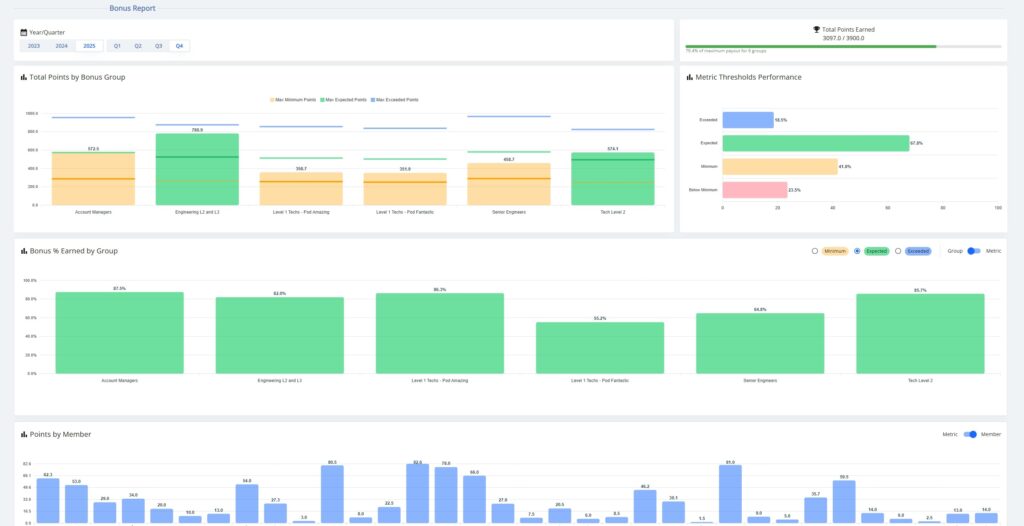
And FITware’s Bonus Program (which ties engineer compensation to the outcomes they actually influence) is what makes the fix stick. It aligns your team’s behavior with the business outcome, so it’s not just leadership watching the dashboard. Everyone has skin in it.
The operational habit that makes this sustainable
A one-time margin audit is useful. Even better is regular margin reviews cadence to actually change the trajectory of the business.
The MSPs who hold margin consistently over time share a few practices that don’t feel complicated once you’re doing them. They review client profitability on a schedule – not when something feels wrong, but as a standing quarterly or monthly discipline. They have a pricing review process tied to contract renewals so that underpriced relationships don’t auto-renew indefinitely. They track productive hours as a metric, not just ticket close rates, so they can see where engineer time is actually going before it becomes a staffing problem.
None of this requires more meetings. It requires having the data in a form you can actually act on, reviewed on a cadence you actually keep. The business owners who solve this problem permanently are not smarter than the ones who don’t. They just stopped accepting aggregate numbers as a substitute for real visibility.
“The MSPs who grow well are not the ones who grow fastest. They’re the ones who know exactly what they’re growing into.”
What would your margin looked like if….
….you stripped out your three most profitable clients? Not blended. Not aggregate. Just the rest of the business, standing on its own.
Most MSP owners have never run that number. Many are quietly afraid to. That fear is worth paying attention to – because in most cases, the businesses that feel fragile even when revenue is growing are fragile exactly because the margin is sitting in three places, and everywhere else is breaking even at best.
The good news is that visibility is fixable. The business you have right now might be worth a lot more than it currently earns, if you can find where the margin is leaking and close it. That work is not glamorous. But it is the work that compounds.