
It’s Tuesday afternoon and you’re on the phone with a prospect. They ask the question you’ve answered two hundred times: “What do you charge per seat?” You give them your number. It’s the same number you’ve been giving for two years, give or take a few dollars. It felt right when you set it. It still feels right. The deal closes. You move on.
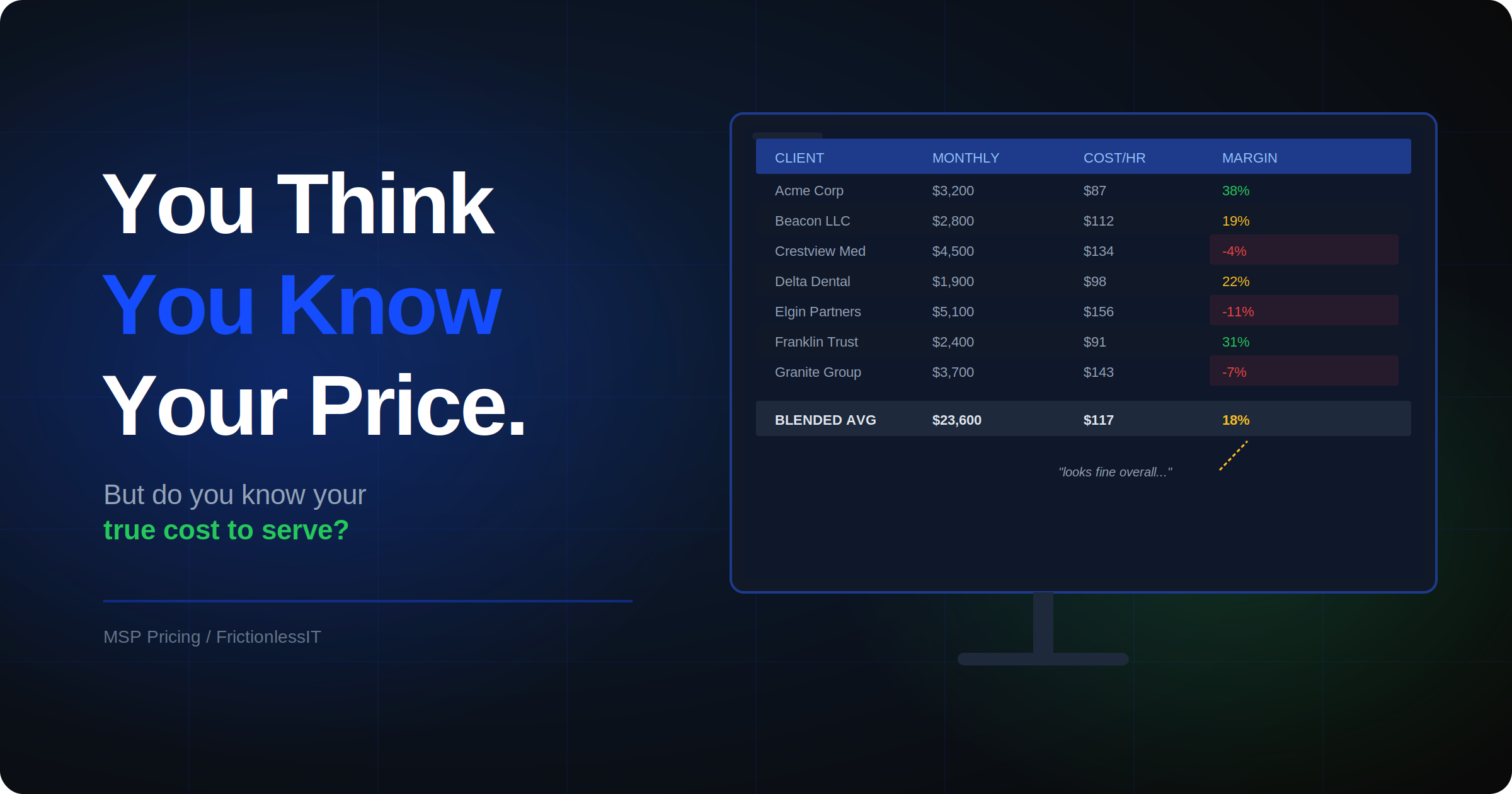
Three months later, that client has added fourteen devices, integrated a VOIP system you didn’t scope, and your most experienced tech is spending eleven hours a month just keeping their aging server stack breathing. You’re billing $3,800. You’re spending $4,200 to serve them. Nobody has noticed. The revenue line looks fine.
“Pricing is the one decision in your MSP that quietly determines everything else. And some owners make it with worse data than they use to buy a used car.”
How an MSP’s pricing problem gets made
Nobody sets out to underprice their services. It usually starts sensibly enough: you look at what a competitor is charging, maybe pull a ConnectWise or CompTIA benchmarking report, and land on a number that feels competitive but leaves room. You win the deal. You do good work. The client is happy. That success calcifies into a default.
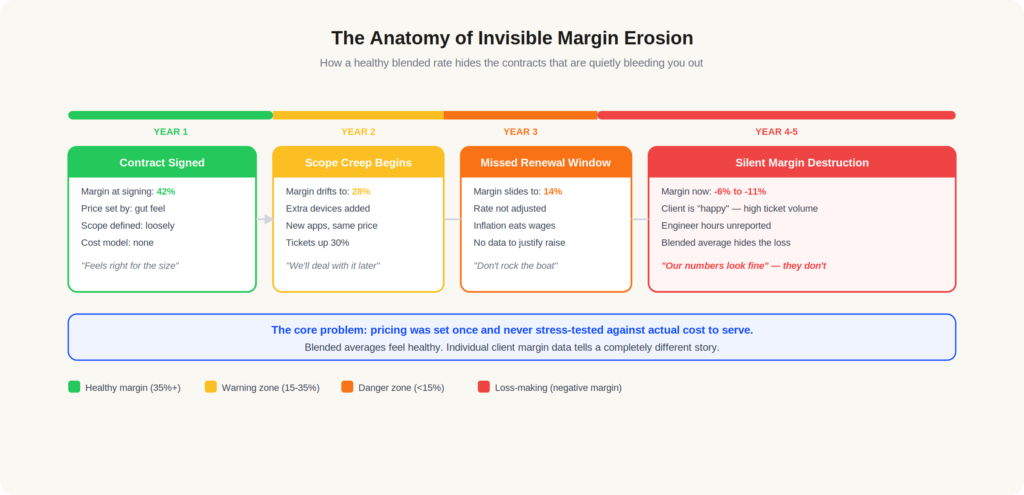
The problem isn’t the original number. The problem is the absence of a feedback loop. Nobody is checking whether that number still makes sense six months later, or measuring how many hours it actually took to service that client versus how many the pricing model assumed. The contract renews. The margin erodes. The spreadsheet still shows green because you’re looking at revenue, not cost.
This is how healthy-looking MSPs end up with solid EBITDA %s on the surface and two or three clients quietly destroying it underneath.
What r/msp already knows about this
Scroll through r/msp for ten minutes and you’ll find some version of this post every week: “Just did a real cost analysis on my client base for the first time. I’m losing money on 30% of them. What do I do?” The replies are always the same mix: some people say reprice immediately, some say fire the clients, and a few brave souls admit they’ve never actually run the numbers themselves.
The conversation is almost always reactive. Something forced the analysis: a financial review, a near-miss on payroll, or a particularly brutal quarterly assessment from an accountant who asked one inconvenient question. Rarely does it happen proactively, as a structured part of how the business runs.
The practitioners who have gotten ahead of it say the same thing: once you see your actual cost-to-serve data, you cannot unsee it. The client you thought was your anchor becomes the weight dragging the whole business down. The client you were about to fire for being “high-maintenance” turns out to be your most efficient account.
What this actually looks like under the hood
The mechanical failure is straightforward. MSP pricing models are typically built on seat counts, sometimes tiered by device count or complexity category. But none of that captures what actually matters: how many hours does it take to keep this client running, and what does each of those hours cost you?
A 25-seat law firm with ancient on-prem infrastructure, an IT-averse senior partner, and a rotating door of support requests is not the same as a 25-seat SaaS company running everything in the cloud. Price them the same way and you’ll be subsidizing one with the other. Usually for years, because nothing in your PSA data will surface it unless you go looking.
The blended average is the real villain here. Your overall margin might show 22%. That feels okay. But inside that 22% are clients running at 45% and clients running at -8%. The healthy ones are quietly subsidizing the broken ones, and you have no idea which is which because you never looked at the numbers per client.
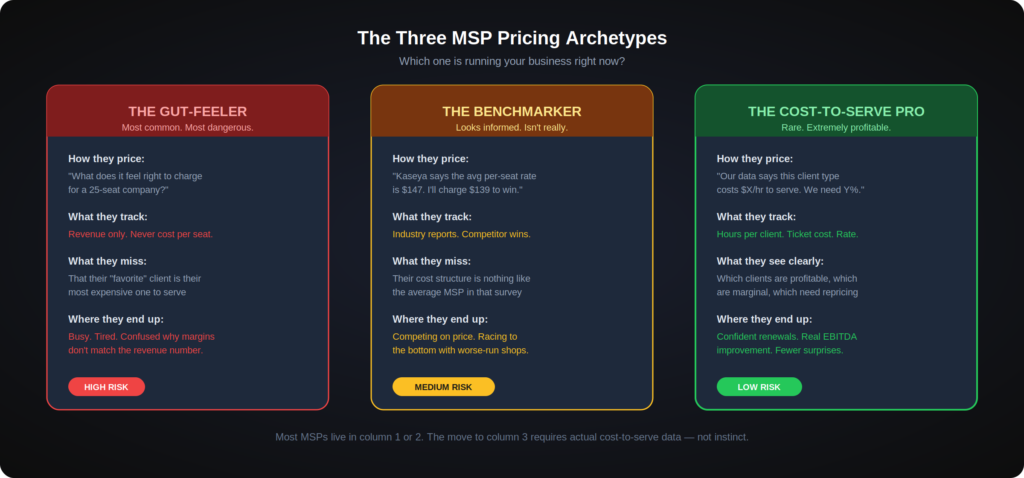
The Gut-Feeler
Most common. They set pricing by feel, by rough competitive awareness, and by what closed deals at in the past. They track revenue religiously and cost loosely. They’re usually busy, usually tired, and can’t figure out why the revenue growth isn’t translating to the bank account. Their pricing was right the day they set it and wrong every day since.
The Benchmarker
More sophisticated-looking. They’ve read the industry reports. They know what the “average MSP” charges per seat. They use that as an anchor. The problem: industry averages tell you what other MSPs charge, not what it costs your MSP to serve your clients with your staff and your toolset. You are not the average MSP. Your clients aren’t either.
The Cost-to-Serve Pro
They have a pricing model built on their actual cost structure. They know what each client tier costs to service. They reprice on a cadence. When they walk into a renewal conversation, they’re not guessing whether the number still makes sense. They know. These are the MSPs with consistent high EBITDA and the least amount of chasing-their-tail energy in their business.
The hidden cost of getting this wrong
The obvious cost is margin erosion. The less obvious costs are subtler and more damaging. Underpriced clients attract more underpriced clients – because you built your sales motion around a number that doesn’t support the business. Your techs burn out serving accounts that require more than the revenue justifies. You can’t afford to hire because the margin isn’t there. You can’t raise prices because you have no data to back it up in the conversation.
And then there’s the strategic cost. MSPs heading toward any kind of exit or valuation event are going to face hard questions about their margin profile. A PE buyer or strategic acquirer will pull your numbers apart by client within the first week of due diligence. If your pricing has been inconsistent and your margins are muddy, that lands directly on your multiple. Not as a negotiating point. As a permanent discount.
FITware’s Client Rates report is built specifically to surface what most MSPs can’t see in their PSA: the actual effective hourly rate per client, set against your real cost structure. Paired with the Productive Hours dashboard, it tells you not just what you’re charging but whether the hours being invested in each account justify it. That’s the data that drives confident repricing conversations – and makes the blended average metric irrelevant.
What a real pricing reset looks like
Here’s a version of a story that can play out: an MSP owner does their first real cost-to-serve audit and discovers that six of their seventeen clients are eating margin they don’t have. Two of those six are among their longest-standing clients. One of them is the client they most often reference in sales conversations as a success story.
The temptation is to panic. Instead, they work the numbers: what does a fair price for each of those accounts actually look like? In some cases it’s a 15% increase. In two cases it’s closer to 25%. They have the data. The conversations are harder than they expected and easier than they feared. Four clients accept the increase. One negotiates to a smaller scope. One leaves.
Revenue drops 8%. EBITDA improves by 8 points. The owner works fewer hours because the tech time is now concentrated on accounts that pay for it. The client who left? They were the one consuming the most time. Their departure freed up capacity for two new clients priced correctly from day one.
This is the counterintuitive reality of cost-to-serve pricing: less revenue, more profit, better business.
Building a system around pricing, not gut instinct
The one-time audit is valuable. But the ongoing system is what actually changes the business. A pricing system has three components: a cost model (what does it actually cost to serve each tier of client), a review cadence (when do you look at margin per account and act on it), and a repricing framework (what triggers a conversation and how do you have it).
The cost model doesn’t need to be a PhD thesis. It needs to capture your fully-loaded labor cost, your tool cost per seat, your overhead allocation, and your target margin. The review cadence can be quarterly. The repricing framework just needs to answer two questions: at what margin threshold do we start the conversation, and what’s our process for structuring it.
MSPs that operate this way don’t have pricing anxiety. They walk into renewal conversations with a clear position. They know which clients are profitable and which are marginal. They make client acquisition decisions based on whether the new logo fits their economics – not just whether they like the prospect.
“The MSPs who price with confidence aren’t guessing better. They’re not guessing at all.”
A different question to ask yourself
The usual question is: are we charging enough? The more useful question is: do we actually know what it costs to serve each client? Because you can’t answer the first without the second. You can take a guess, and most MSPs do, and the guess works until it doesn’t.
The data exists in your PSA. Hours are being logged. Tickets are being closed. The cost structure exists in your payroll and your vendor contracts. Nobody has connected those two things into a picture that shows you what each client actually costs to serve. That connection is the whole game.
Build it once. Review it quarterly. Stop pricing on gut feel. That’s the entire playbook.